



As summarized from the project’s report by Yosi Pinto, SDA President
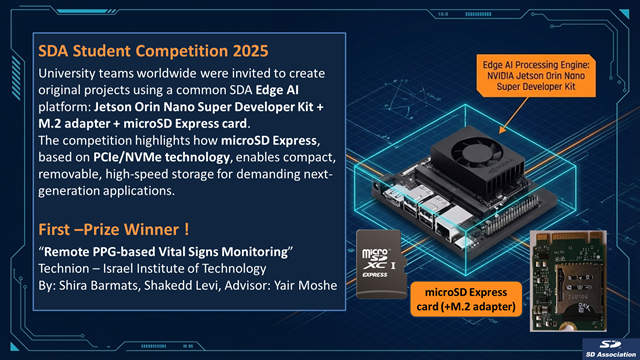
The 2025 SDA SD Express Student Competition challenged students to think boldly about how next-generation SD Express, a removable NVMe storage, can enable AI at the edge. To support student innovation, SDA provided participating teams with NVIDIA Jetson Orin™ Nano Super Developer Kit, together with an M.2 adapter and a microSD Express memory card, to serve as the sole storage source while leaving the project topic fully open to the students’ creativity. This combination of limitless creativity and powerful technology led to a wide range of ideas—but the first prize-winning submission from Technion Israel Institute of Technology stood out. The submission demonstrated a new potential in health technology, and for demonstrating SD Express storage performance an essential part of the solution rather than just a background component.
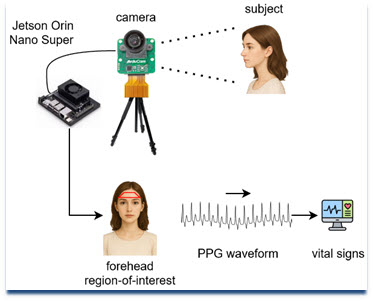
The Remote PPG-based Vital Signs Monitoring solution was developed by Shira Barmats and Shakedd Levi under the supervision of Yair Moshe at the Signal and Image Processing Laboratory of the Technion’s Faculty of Electrical and Computer Engineering. The team built a contactless monitoring system based on remote photoplethysmography (rPPG) – a technique that estimates physiological signals such as heart rate by analyzing subtle color variations in facial skin captured by a camera. Their system records uncompressed 1440p facial video at 30 frames per second while simultaneously running a lower-resolution real-time pipeline for immediate user feedback.
The project builds on an active and growing area of research. Conventional photoplethysmography uses optical sensing at the skin surface, whereas remote PPG extends this concept into the imaging domain, allowing a camera to measure tiny periodic skin-color changes without physical contact. This makes the technology attractive for telehealth, wellness, and other situations where comfort, hygiene, convenience, or passive monitoring are important. The students also note several known challenges identified in scientific literature, including motion, changes in illumination, and signal degradation caused by video compression. Their project idea directly addresses these issues by preserving high-resolution, uncompressed video for later processing, while still offering a live operating mode.

The unique dual-mode architecture separates immediate responsiveness from ultimate signal quality. In the team’s design, the system captures native 2560×1440p video from a camera and writes the stream uncompressed to the microSD Express card. At the same time, the video is downscaled to 720p at 15 fps for real-time processing, enabling live heart-rate feedback with manageable latency. Once recording is complete, the higher-quality stored video can be processed offline to generate more accurate measurements and additional metrics. Instead of forcing the system to choose between fast enough and good enough, the students demonstrated that microSD Express does both.
The solution uses MediaPipe FaceMesh for facial landmark detection, localizes a forehead region of interest, and reconstructs a physiological waveform from that region. The students chose model-based rPPG methods rather than more data-hungry learning-based approaches, specifically supporting Plane-Orthogonal-to-Skin[1] (POS) and Pulse Blood Volume[2] (PBV) methods. The learning-based methods also impose higher computational cost and often generalize poorly across cameras, frame rates, skin tones, and lighting conditions. After waveform preprocessing, the real-time path outputs heart rate, while the offline path can produce not only a more accurate heart rate estimate but also additional metrics such as heart-rate variability, respiration rate, and a stress/fatigue index. This architecture shows advanced engineering judgment by balancing computational limits, algorithmic robustness, and practical deployment constraints on an edge system.
The initial test results are promising for any type of prototype. Using a dataset of 10 recordings from five participants, each measured once at rest and once after brief physical activity, the team compared its results against a Polar Verity Sense reference device. The system achieved a mean absolute error of 8.3 bpm in real time and 6.6 bpm offline when using the POS method. The offline improvement is important because it supports the project’s central thesis: when the system preserves high-fidelity, uncompressed video, later processing can extract a cleaner physiological signal and produce enhanced results.
From a medical and societal perspective, this project should be viewed as an early prototype, not as a finished clinical product. Still, it points toward several potentially valuable directions. A contactless vital signs system could eventually support consumer wellness, remote care, screening scenarios, or at-home follow-up, especially where simplicity and hygiene matter. It may also be useful in research settings, where retaining high-quality raw data is valuable for algorithm development and retrospective analysis. Even if a system like this is not immediately used for medical diagnosis, it may contribute to a broader trend toward more accessible and less intrusive physiological monitoring – a meaningful contribution by itself.
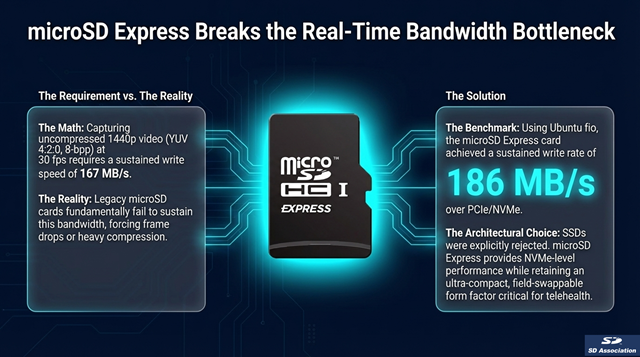
The project also highlights a broader scientific point: edge AI and computer-vision systems often benefit not only from more compute, but from the ability to capture and preserve more information at the source. This is where microSD Express becomes central. In many situations, storage is treated as passive infrastructure. In this one, storage is an active enabler of the entire concept. The project showed that writing a 1440p YUV 4:2:0, 8-bit stream at 30 fps requires about 167 MB/s of sustained write bandwidth, and it explicitly notes that legacy microSD memory cards cannot sustain such performance. By contrast, the team measured about 186 MB/s sustained write throughput using Ubuntu™ FIO (Flexible IO Linux tester) on the 256 GB microSD Express card, which allowed the application to reliably record 1440p uncompressed video at 30 fps. In practical terms, that means microSD Express made this innovation possible to preserve the original video quality needed for better offline rPPG analysis while still benefiting from the compact, removable, field-swappable form factor of a memory card.
The students specifically explain that they selected microSD Express instead of an SSD not only for performance, but also for its ultra-compact, field-swappable form factor and the ability to physically transfer recordings between devices. This is a strong reminder that performance alone does not define system value. In many edge applications—especially portable, embedded, or field-deployed systems—the right solution is the one that combines speed, size, convenience, and workflow flexibility. microSD Express delivered the perfect combination here.
The Technion team’s first-prize project is therefore notable on several levels. It is a thoughtful application of existing rPPG research, a well-executed embedded implementation on Jetson, and a strong example of how microSD Express can enable edge workloads that would otherwise be impractical with legacy removable storage. Most importantly, it demonstrates the broader spirit of the SDA Student Competition: give talented students an advanced platform, let them explore freely, and discovering new and impactful use cases that connect storage innovation with real-world benefit. This project did exactly that.
You are welcome to see a live demo of this project at the SDA booth #R0902 at Computex 2026 in Taipei in which the SD Association will proudly host the winning team from the Technion.
For more information on the SDA’s SD Express student competition 2025 can be found here.
If you are a student or faculty member in a highly ranked university and are willing to join the SDA’s 2026 competition, please contact our SDA help desk: help@sdcard.org
For more information on SD Express in general – use this link.
Jetson Nano is a registered trademark of NVIDIA Corporation.
Ubuntu is a registered trademark of Canonical.
[1] POS projects the normalized RGB signal onto two chrominance directions orthogonal to the skin-tone vector, then combines them with adaptive weights to yield a robust PPG signal.
[2] PBV treats the blood-volume pulse as a subtle periodic modulation in skin reflectance and uses color-space projections to amplify the pulsatile component while suppressing motion and lighting artifacts.