




AI isn’t just in the cloud anymore. It’s showing up in cameras, robots, medical devices, wearables, and smart infrastructure – right where data is created. This shift to AI at the edge is changing how systems are built and what they can do in real time.
Across consumer, industrial, and embedded systems, edge AI is driving demand for storage that’s not only fast but also compact and energy efficient. Storage performance now plays a direct role in how quickly models load, how smoothly data moves through AI pipelines, and how responsive systems can be in real-world conditions.
That’s where SD Express excels. By bringing PCIe® and NVMe™ performance to removable storage, SD Express enables high-speed data access and low latency in space- and power-constrained designs, making it a key enabler for the rapid growth of edge AI applications.
The 2026 SD Express Student Competition builds on this momentum by giving students a hands-on platform to apply what they’ve learned in the classroom to real-world system design. Instead of working only on theory, participants design, build, and test working edge AI systems that show how advanced storage can shape overall system performance.
Review the SDA Student Competition Call for Entries
Purpose of the SD Express Student Competition
The SD Express Student Competition was created to close the gap between what students learn in the classroom and what engineers build in the real world. The first competition occurred in 2025.
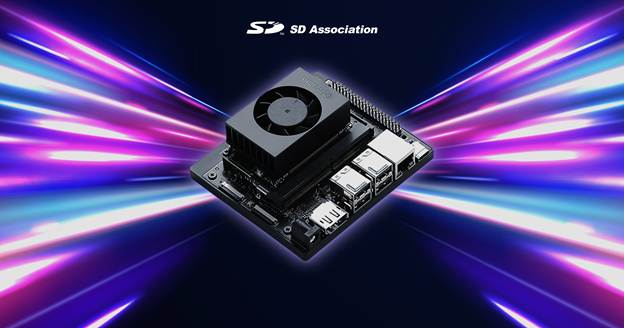
Students are challenged to design AI-at-the-edge systems using NVIDIA’s Jetson Orin Nano Super Developer Kit, plus an M.2 to microSD Express adapter with a microSD Express memory card. There’s no predefined problem to solve or script to follow. Instead, participants choose their own project ideas and show how fast, efficient storage can unlock new capabilities from real-time inference and high-speed data logging to smoother, more responsive AI pipelines.
At its core, the competition reflects the SD Association’s broader mission of connecting academic learning with industry trends. Students work with standards-based technologies already used in commercial products, gaining firsthand experience with the same design considerations faced by professional engineers.
It’s an opportunity to experiment with industry-standard tools, make real design innovations, and see how storage performance shapes system behavior in edge AI applications.
Technical Framework and Development Environment
All projects in the competition are built within a standardized and widely adopted development environment, allowing students to focus on innovation rather than platform selection. Each team uses an NVIDIA Jetson Orin Nano Super Developer Kit with the M.2 to microSD Express adapter and microSD Express memory card (microSD Express v7.1 with PCIe Gen3.1).
This mirrors how many commercial and research systems are built today. Because the platform is standardized, students can focus on what really matters: innovative system architecture, performance tuning, and application behavior.
With its PCIe® and NVMe™ interface, microSD Express delivers up to ~10 times faster throughput and lower latency than traditional microSD memory cards. That means students can explore topics like real-time AI inference, fast access to large models, high-speed sensor data, and local processing without relying on the cloud.
This environment encourages hands-on learning and meaningful experimentation.
Project Scope and Application Areas
One of the best parts of the competition is the freedom it gives students. There’s no single “right” project. Students define their own scope and architecture, leading to innovative submissions in areas such as robotics, mobile medical devices, environmental monitoring, smart automotive systems, and wearables, while leveraging advanced technologies including computer vision, machine learning, and sophisticated digital data processing – all powered by AI algorithms.
Learn more about past projects here.
Regardless of the application, projects must clearly explain why and how microSD Express enables the overall system performance and showcase fully functional, demonstrable systems, not just concepts.

Evaluation Criteria and Technical Expectations
Three winning projects are selected based on a structured evaluation framework designed to emphasize real engineering impact:
- Quantitative demonstration of microSD Express advantages (40%)
- Incorporation of new technologies such as AI/ML, robotics, AR/VR, or gaming, with relevance to consumer or mass-market products (25%)
- Functioning, demonstrable system (20%)
- Creativity and originality (5%)
- Clarity and quality of the submission (10%)
Judges look for thoughtful system architecture, measurable performance data, and clear explanations of design decisions. In addition, students are expected to show how storage performance directly affects overall system behavior and user experience.
Why Should Students Participate?
Participating students gain hands-on experience with industry-grade AI hardware and advanced storage technology. They develop skills that go far beyond typical coursework, such as:
- System-level architecture and integration
- Performance benchmarking and analysis
- Balancing compute, memory, and storage in AI workloads
It’s also a chance to expose your work to people in the industry who build real products every day.
The top three teams receive:
- $20,000 for first place
- $10,000 for second place
- $5,000 for third place
First-place winners are invited to present at an SD Association trade show, and students keep full ownership of their intellectual property. That means you can keep building, improving, or even commercializing your idea after the competition.
Educational and Industry Relevance
For faculty advisors and institutions, the SD Express Student Competition aligns closely with modern engineering curricula and applied research goals. It reinforces system-level thinking around performance, power efficiency, and data management, while exposing students to memory and storage challenges that are central to today’s markets.
Students also gain exposure to SD standards that are widely used across consumer electronics, automotive systems, industrial devices, and IoT products. This is a practical experience that complements coursework and research in a meaningful way.
Participation Details and Key Dates
Key milestones for the 2026 competition include:
- Registration opens: February 1, 2026
- Registration closes: April 30, 2026
- Project report submission deadline: September 15, 2026
- Winners announced: Around October 15, 2026
Early planning and faculty engagement are strongly encouraged to maximize project success.
Invitation to Innovate
As AI continues its shift toward the edge, high-performance removable storage like SD Express is becoming a key enabler of what’s possible.
The SD Association created this competition to give students the tools, freedom, and platform to explore that future hands-on. The 2026 SD Express Student Competition challenges students to move beyond theory and demonstrate how advanced storage can power smarter, faster edge AI systems.
If you’re ready to build something real and turn ideas into impact, this competition is your chance to get started.
Find More Information in the SDA Student Competition Call for Entries