



Data creation is accelerating. Artificial intelligence (AI), high-resolution imaging, autonomous systems, and connected devices are transforming how we capture and process information, driving an unprecedented need for fast, secure, and flexible local storage.
SD memory technology stands at the center of this evolution. As demand grows for performance, capacity, and reliability, the SD Association (SDA) continues to lead the development of global standards that ensure interoperability and innovation. In 2026, SD technology will set the foundation for a new era of intelligent, connected, and sustainable data systems.
Six Trends Defining SD Innovation in 2026
- SD Express becomes the performance standard of small removable memory cards.
- Gaming as a major driver of SD innovation and performance.
- Capacity scales with SDUC (SD Ultra Capacity) to meet multi-terabyte workloads.
- The creator economy accelerates demand for speed and portability.
- AI and edge intelligence require high-throughput local storage.
- Durability, reliability, and sustainability become core product requirements.
Trend 1: SD Express: The New Performance Standard
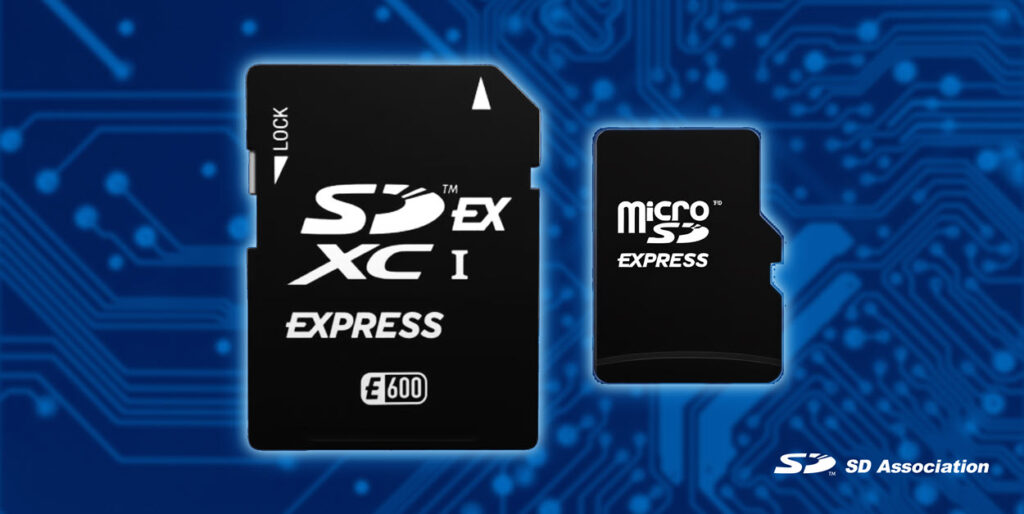
SD Express has evolved from innovation to proven, mainstream standard, and the market will continue expanding in 2026 as demand for high-speed removable storage accelerates.
- Combines PCIe® and NVMe™ interfaces, delivering SSD-class speeds of up to ~1GBs with PCIe 3 x1 (SD7.0) and up to ~4GB/s with PCIe Gen4 x2 interface (SD8.0).
- The PCIe/NVMe interfaces deliver not only throughput speed but also much faster random access, required for applications running out of the card, as well as more advanced networking capabilities (DMA between PCIe devices, Host Memory Buffer (HMB) and more open new potential use cases for removable media.
- Retains the familiar SD and microSD form factors, ensuring compatibility with existing SD UHS-I designs.
That momentum is visible across the ecosystem.
- SD Express and microSD Express memory cards from ADATA, Lexar, Sandisk, Samsung, Team Group, AGI Technology, DATO, GTS Total Solutions, Nextorage, PATRIOT, Phison, PNY, and Transcend demonstrate wide adoption across devices and use cases.
- Host systems from Acer, ASUS, Dell, HP, Intel, Lenovo, MSI, and XMG now ship with SD Express compatibility. Additionally, the latest advanced handheld gaming console Nintendo Switch 2 uses the microSD Express as a true memory expansion solution for games storage and execution, along with associated data.
- Accessories and readers from Delock, Maiwo, Lexar, and Sabrent, along with card’s controllers from Phison and Silicon Motion and PCIe/USB to SD Express bridge solutions from Realtek, Genesys, JMicron, and BayHub , further expand the ecosystem and simplify integration for developers.
- The SD Express memory card reader market is projected to grow 7.8% from 2025 to 2033, expected to reach $3.07 billion.
As SD Express is adopted further, developers can expect higher throughput, greater energy efficiency, and tighter integration in new tech. In a world increasingly dependent on the cloud, SD Express empowers users and organizations to own their data rather than rent it, ensuring access even when networks fail.
Trend 2: Powering the Next Generation of Gaming
Gaming is one of the fastest-growing applications for SD technology, driving demand for high-speed, high-capacity removable storage that keeps pace with modern game performance. It’s not just about faster data transfer – it’s about delivering a superior user experience, which has become a standard expectation among gamers.
The Nintendo Switch 2 handheld gaming consol, introduced in 2025, was the first to adopt microSD Express as its primary removable memory solution. These cards store games and their associated data, while enabling ultra-fast downloads, rapid game launches, and smooth operation of demanding, high-resolution graphics. With large memory capacity and high-speed connectivity, microSD Express allows Nintendo to offer lower-cost consoles with easy, expandable storage, delivering a seamless and exceptional gaming experience.
Most leading gaming devices today still use standard microSD slots, but the advantages of microSD Express (speed, capacity, and performance) make it a compelling solution for the next generation of gaming platforms.
As handheld, console, and cloud-connected systems evolve toward richer visuals and larger game assets, SD technology provides the speed, scalability, and efficiency needed to power these increasingly, on-demand, local, data-intensive experiences.
How does SD memory technology level up the gaming experience?
- SSD-class speeds through SD Express and microSD Express reduce load times and accelerate updates of large-scale-capacity games.
- Real-time capture, streaming, and playback in 4K and 8K enhance gameplay and sharing experiences.
- Local storage independence ensures uninterrupted play and recording, even without cloud access.
The global gaming market is projected to grow from $299 billion in 2024 to $600 billion by 2030, highlighting continued expansion across both entertainment and e-sports ecosystems. SD Express is well positioned to support this growth, giving developers and hardware designers flexible, scalable storage solutions that enhance performance while maintaining portability.
SD memory remains the foundation of modern gaming, enabling faster, smoother, and more immersive play across consoles, handhelds, and next-generation systems.
Trend 3: Scaling Capacity with SDUC
AI, imaging, and immersive workloads now produce terabytes of data daily, making ultra-high-capacity storage essential. SDUC (SD Ultra Capacity) starts at 2TB and scalesup to 128TB, enabling devices to handle massive datasets without sacrificing portability or efficiency.
- 3D NAND stacking and other new, evolving memory technologies increase density within the same footprint.
- Enhanced error correction (EEC) extends endurance and reliability.
- SDUC cards in multi-terabyte capacities are already shipping, signaling mainstream adoption.
Developers benefit from SDUC’s design-once, scale-anywhere approach, which allows a single hardware design to support multiple capacity tiers and future upgrades without major redesigns.
SDUC storage supports a range of fast-growing applications:
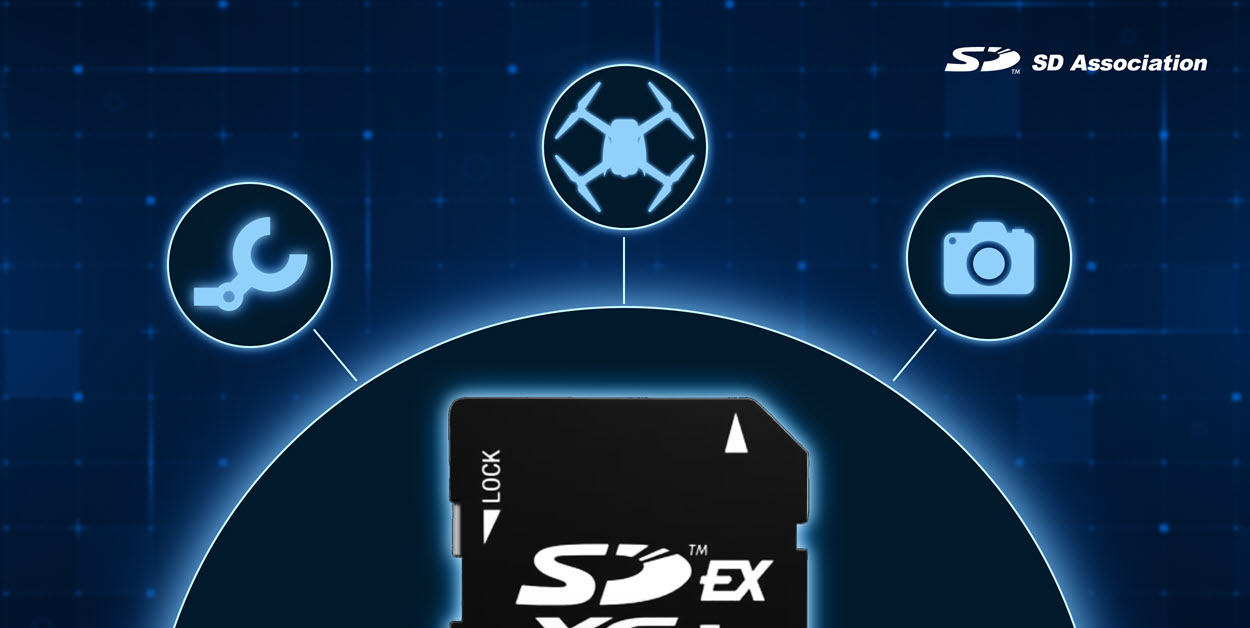
- Autonomous drones capturing high-resolution visual data. The drone market is expected to reach $160.3 billion by 2030.
- Virtual Reality (VR)/Augmented Reality (AR) headsets streaming immersive content locally, and the VR market is projected to reach $284 billion by 2034.
- Edge AI devices performing inference and caching data offline. The edge AI market is forecast to grow 21.7% per year to reach $118 billion by 2033.
Each use case demands high-performance, high-capacity, low-power storage: strengths that define SDUC.

Trend 4: Empowering the Creator Economy
The creator economy, valued at roughly $205 billion and expanding rapidly, is transforming how content is produced, edited, and shared. Creators now work across 4K to 16K video, RAW photography, and 3D or VR/AR assets, generating more than 120 GB per minute in professional settings. These workflows demand high-speed, high-capacity, and reliable local storage that can keep pace with modern production.
How SD Delivers
- SD Express supports real-time capture, rapid file transfer, and on-the-go editing, helping creators work efficiently in the field.
- SDUC provides multi-terabyte storage for archiving large media libraries and transporting footage between locations.
From independent filmmakers to global studios, professionals rely on removable SD storage for collaboration, backup, and post-production.
SD memory cards remain the creative foundation of digital media workflows, enabling seamless content creation without dependence on cloud transfers or high-bandwidth connections.
Trend 5: AI and Edge Intelligence
As industries become increasingly cloud-dependent, the need for local control and data availability is growing. Alongside the expansion of large AI data centers, a significant shift toward edge computing is underway – bringing processing closer to where data is generated. This transition improves privacy, reduces latency, and enables real-time decision-making, ensuring continued operation even when connectivity is limited.
The global edge AI market reflects this momentum, projected to reach $118 billion by 2033, driven by adoption in automation, logistics, healthcare, and consumer electronics. SD Express provides the storage foundation that edge systems need.
Why SD matters:
- Edge systems handle massive visual, audio, and sensor data requiring fast, reliable local storage.
- SD Express provides the speed and flexibility to store datasets, manage logs, and perform model updates on-device.
- PCIe®/NVMe™ architecture supports SSD-class performance – read/write and low latency, while SDUC capacities (up to 128TB) meet data-intensive needs.
- Low power, broad compatibility, and high-grade durability make SD ideal for resilient edge environments.
In 2025, the SDA held a worldwide Student Competition featuring SD Express cards used on NVIDIA’s Jetson Orin Nano Super AI-flexible development board (with an M.2-to-microSD Express adapter). A total of 21 projects were submitted, most of which implemented various AI-at-the-edge solutions.
SD Express technology delivers the flexibility developers need to deploy AI confidently at the edge.
Trend 6: Durability, Reliability, and Sustainability
Performance and capacity are only part of the equation. SD technology continues to lead in endurance.
- New quality standards, such as endurance and performance measurements, are being developed by the SD Association in response to the growing demand for products with these core requirements.
- If you are not yet an SDA member, please click here to view these standards.
- Industrial and high endurance SD memory cards are built for long lifecycles and harsh environments.
- New materials like stainless steel (like in Lexar’s stainless steel SD memory cards) improve physical strength and resilience.
- Removable, reusable design reduces e-waste and extends product lifecycle compared to soldered storage.
SD technology integrates durability and sustainability into high-performance design, essential for professional and industrial use.
A Vision for 2026 and Beyond
The next era of storage is already taking shape. SD Express performance, SDUC capacity, and AI at the edge are converging to redefine how data is captured, processed, and shared.
As devices become smarter and more connected, SD technology gives developers the tools to own their data, design for resilience, and build for scalability. Backed by global standards, proven interoperability, and expanding industry adoption, SD remains the trusted foundation for innovation.
Now is the time for developers and engineers to integrate SD Express technology into their next designs, delivering faster, more reliable, and future-ready systems that keep data close and intelligence even closer.
SD trademarks are owned and licensed by SD-3C LLC.
PCI Express® and PCIe® registered trademarks of PCI-SIG®.
NVM Express™ and NVMe™ are trademarks of NVM Express, Inc.