



Modern game development has quietly become a storage engineering problem.
Install sizes continue to grow. Live-service titles push constant updates. It is now common for modern games to exceed 100GB installs. At the same time, the line between removable and internal storage is blurring.
On handheld and mobile-style platforms, there may be limited or no internal SSD space. This shifts storage from “where the game sits” to “what the game runs on.”
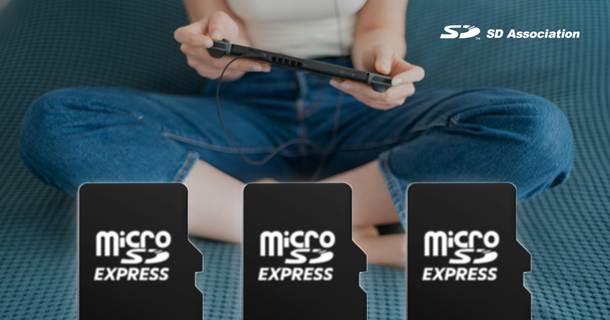
Meanwhile, newer SD memory card interfaces are raising performance ceilings with SD Express, delivering PCIe® and NVMe™ into SD memory cards. This signals a meaningful shift. Removable storage is no longer just an accessory. It is becoming part of the primary system architecture.
SD Memory Cards’ Role
This shift is already playing out in next-generation handheld systems, where faster SD Express storage is being adopted to support larger game sizes and smoother gameplay experiences.
For developers, that evolution expands what is possible. It reduces constraints on portable experiences, enables more flexible content delivery, and supports higher-performance designs without sacrificing interoperability.
But this environment also introduces a new constraint. Developers are designing for storage they do not control. Users choose their own SD memory cards, meaning performance can vary within a defined range. Unlike consoles or PCs with fixed specifications, developers must account for unknown but bounded variability.
In that context, raw performance specs matter less than predictability. SD Association standards provide a framework developers can design against by defining clear, reliable expectations for how storage behaves rather than leaving it to chance.
Storage Is Part of the Runtime
Storage is no longer just where games live. It is part of how they run. Modern workloads include:
- Large sequential reads such as initial game loading and during runtime when loading new graphical environments, level loads, and textures
- Large sequential writes such as patches and installs
- Frequent small reads and writes such as caches, save data, and metadata
On portable platforms, removable storage often sits directly in the execution path. That means storage behavior can directly impact load times, streaming consistency, and patch reliability.
For developers, the key question is no longer “how big is the game?” but instead: “What kind of storage workload does the game create?”
Looking Beyond “Speed”
It is tempting to reduce storage requirements to a single metric. But “fast” does not reflect how games actually use storage.
A game might stream large assets continuously, update incrementally in small chunks, and access thousands of small files during runtime. Each of these stresses storage differently.
The value of SD standards is not that it defines the fastest option. It provides a structured way to think about storage performance. By separating capacity, throughput, and application behavior, it allows developers to align storage characteristics with real workloads.
This distinction is increasingly important as modern storage technologies assume SSD-level performance in portable formats. SD Express, for example, leverages PCIe® and NVMe™ interfaces to significantly increase sequential bandwidth while reducing random access latency and improving efficiency for demanding workloads.

Games Are Increasingly Application-Like
Portable and connected games increasingly behave like an active application. They maintain persistent data, perform frequent background reads/writes, operate alongside system-level processes, and update incrementally instead of reinstalling. This makes consistency and random-access performance just as important as bulk throughput.
SD standards reflect this shift by introducing performance models designed for real-world usage patterns such as mixed workloads, concurrency, and smaller I/O operations. This is the difference between a game that loads quickly once and one that runs smoothly over time.
Designing for Variability in a Standardized Ecosystem
Removable storage introduces variability by definition. Two users may run the same game on different storage configurations, even within the same platform.
The challenge is managing that variability without over-engineering for edge cases.
In systems where continuous sequential access is crucial, SD standards make this manageable by binding performance within defined tiers. Speed classes and performance categories ensure minimum levels of sustained throughput and behavior under defined conditions. In practice, this means:
- Defining a baseline:
Establish minimum storage requirements to ensure a consistent gameplay experience - Recommending an optimal tier:
Signal what level of performance unlocks faster installs, smoother streaming, and fewer interruptions - Designing for graceful degradation:
Adapt behavior when performance drops by adjusting streaming, reducing concurrency, and prefetching more conservatively
For manufacturers looking for even more control over this variability, consider the option of an SD memory card tightly bound to a product host. This is now possible with the TCG and RPMG security features defined in the SD 9 standard, allowing manufacturers to eliminate the risk of a customer using and buying a fake memory card.
Capacity Is a Design Lever
Capacity is not just a user consideration. It directly shapes how games are built and delivered. It influences install footprint, patch size and frequency, modular content strategies, tradeoffs between asset duplication and streaming, and more.
The SD ecosystem’s defined capacity tiers provide a practical reference point for planning. While most modern gaming aligns with higher-capacity storage, the more important takeaway is scalability.
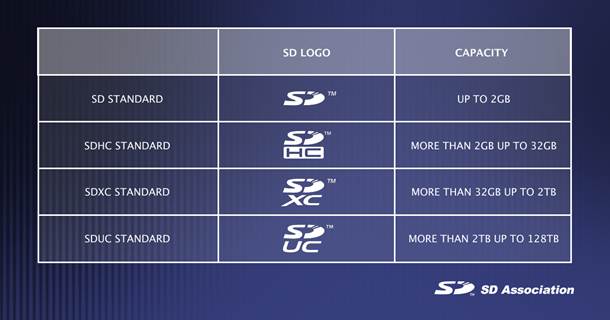
As storage expands, developers gain flexibility to build larger and more persistent experiences and support increasingly expansive game libraries without artificial constraints.
Interoperability Is the Real Advantage
The real strength of SD standards is interoperability.
It provides a shared language for defining storage requirements, ensures predictable behavior across compliant devices, and reduces fragmentation in a diverse hardware ecosystem. Just as importantly, it preserves backward compatibility and consistency as performance evolves.
For developers, this changes the equation. Instead of optimizing for specific vendors or configurations, teams can design against standardized tiers and trust that compliant devices will meet those expectations.
That reduces risk and allows developers to focus on gameplay and system design rather than managing storage edge cases.
Host devices that prefer to limit the usage of their products with only high-speed SD Express cards, may provide a PCIe-only interface with clear guidance for their customers explaining the limitation. In this case, customers may use only SD Express (or microSD Express) cards with the given product while it may still operate their SD Express card on any other standard SD UHS-I products/readers as well, as SD Express cards are always fully backward compatible to SD UHS-I interface.
Practical Takeaways
For developers building on platforms that rely on expandable storage, here are some storage design tips:
- Design around workloads, not peak specs.
Understand how your game reads and writes data in real conditions - Set minimum and recommended tiers.
Use SD standards to define both baseline and optimal experiences - Plan for variability.
Assume a range of compliant storage performance and design accordingly - Consider tight binding of SD memory cards to product hosts.
The binding can be done through declared vendor specific cards (“this product may use only this type of cards from these card vendors” or “this product may use only cards marked to be used for this product”) or it can be bound through secured methods (TCG, RPMB) as defined in theSD 9 specification - Track emerging performance capabilities.
Higher-performance SD technologies will continue expanding what portable games can do
As gaming continues to expand into portable and modular environments, storage has become part of the design’s surface.
SD standards give developers something increasingly valuable: a framework for predictability in a variable ecosystem. It does not remove constraints, but it makes it easier to design around. For teams building the next generation of portable experiences, that clarity is just as important as performance.
Install sizes continue to grow. Live-service titles push constant updates. It is now common for modern games to exceed 100GB installs. At the same time, the line between removable and internal storage is blurring.
On handheld and mobile-style platforms, there may be limited or no internal SSD space. This shifts storage from “where the game sits” to “what the game runs on.”
Meanwhile, newer SD memory card interfaces are raising performance ceilings with SD Express, delivering PCIe® and NVMe™ into SD memory cards. This signals a meaningful shift. Removable storage is no longer just an accessory. It is becoming part of the primary system architecture.
SD Memory Cards’ Role
This shift is already playing out in next-generation handheld systems, where faster SD Express storage is being adopted to support larger game sizes and smoother gameplay experiences.
For developers, that evolution expands what is possible. It reduces constraints on portable experiences, enables more flexible content delivery, and supports higher-performance designs without sacrificing interoperability.
But this environment also introduces a new constraint. Developers are designing for storage they do not control. Users choose their own SD memory cards, meaning performance can vary within a defined range. Unlike consoles or PCs with fixed specifications, developers must account for unknown but bounded variability.
In that context, raw performance specs matter less than predictability. SD Association standards provide a framework developers can design against by defining clear, reliable expectations for how storage behaves rather than leaving it to chance.