



Smartphones are now the primary platform for content creation, productivity, and increasingly, AI-driven computing. From capturing high-resolution video to editing media on-device and running advanced applications, mobile workflows have fundamentally changed how people create and consume data.
This shift has introduced a new reality: mobile data growth is accelerating faster than fixed internal storage can keep up.
Modern smartphones now support high-intensity capabilities – from 4K video capture and computational photography to complex gaming and AI-enabled apps with local caches (explored further in State of Memory Technology and Trends to Watch in 2026.)
At the same time, internal storage remains fixed at the point of purchase, often at an exceptionally high price, forcing customers to commit to more than they might need to avoid running out of storage later on. This creates a fundamental architectural tension: how can devices remain flexible in a world of rapidly expanding data demands?
The answer lies in expandable, standards-based storage. SD and microSD memory cards provide a scalable solution that allows customers of all types (and device designers) to meet right to repair laws and extend storage dynamically, aligning capacity with real-world usage rather than upfront assumptions.
The Economics of Internal vs. Expandable Storage
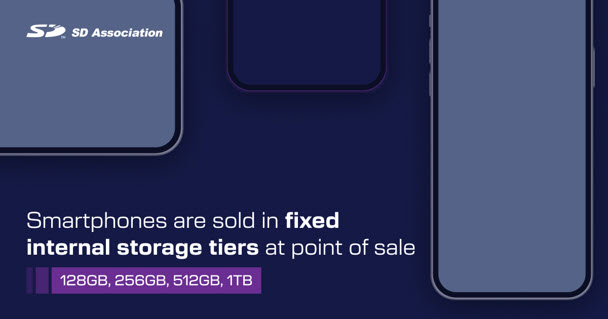
Smartphones are typically offered in fixed storage tiers, locking customers into decisions at the time of purchase. However, this model does not always align with how storage needs actually evolve.
Cost Efficiency and Flexibility
Removable flash storage, including microSD memory cards, often delivers a more competitive cost-per-gigabyte compared to internal storage upgrades, which are frequently sold at a significant markup (source).
This enables a different approach:
- Customers can scale storage incrementally as their needs grow
- Devices can remain relevant longer without requiring replacement
- Entry-level configurations can be more accessible, especially in value-sensitive markets
In practical terms, a customer can purchase a smartphone with lower internal storage and expand it later, either through a microSD memory card slot or via USB-C-connected external storage, creating a more cost-effective and flexible ownership model.
Market Volatility and Design Implications
The global memory market is also becoming more volatile.
For example, contract prices for NAND Flash rose +55-60% in Q1 2026, with convention DRAM contract prices up 90-95%, due to strong AI infrastructure demand and constrained supply, breaking typical seasonal pricing patterns and increasing component costs ( source).
For OEMs, this introduces risk:
- Internal flash pricing, which now accounts for 30-40% of total smartphone production costs, impacts bill-of-materials (BOM) decisions (source)
- Fixed storage tiers must be defined months in advance
- Supply constraints can limit flexibility
- Price increases might negatively impact sales
Standards-based removable storage offers a strategic advantage. By enabling expandable capacity, manufacturers can decouple device design from short-term memory pricing fluctuations, while still meeting the public’s demand for more storage.
SD and microSD Standards: Enabling Modern Mobile Workloads
The strength of SD and microSD memory cards lies not just in their flexibility, but in the robust, evolving standards ecosystem defined by the SD Association.
Scalable Capacity Across Generations
From SD to SDHC, SDXC, and now SDUC, the SD Association has continuously expanded standard capacity limits while maintaining compatibility across generations.
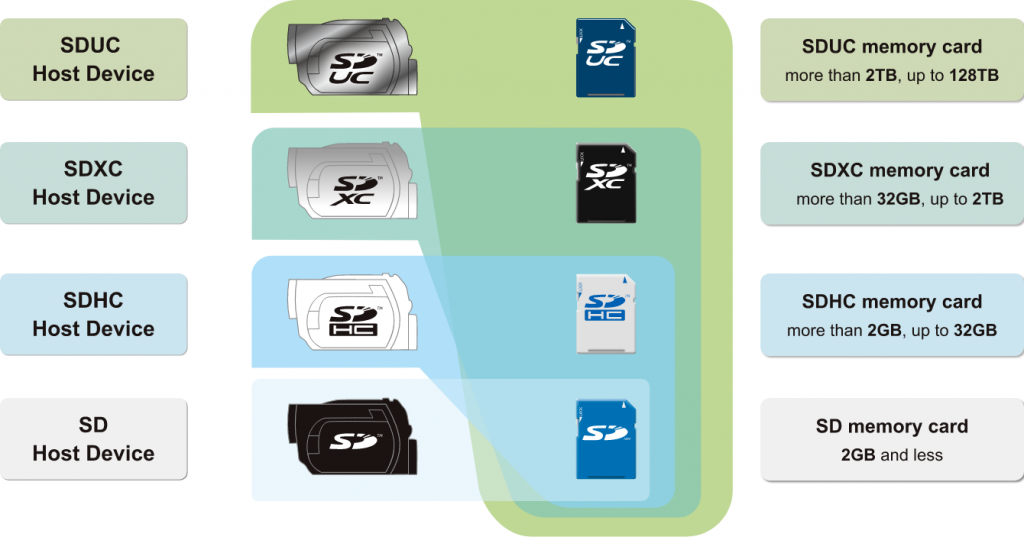
This ensures that devices and users benefit from a clear upgrade path, long-term interoperability, and confidence in ecosystem stability
Both SD and microSD form factors share the same architectural foundation, enabling consistent performance scaling across a wide range of device types.
High-Performance Interfaces and SD Express
As workloads continue to evolve, so does the underlying technology.
All SD form factors can use UHS interfaces to support faster bus speeds. SD Express and microSD Express leverage the PCIe® and NVMeTMarchitecture protocols into both form factors, enabling lightning-fast performance levels comparable to SSDs. This advancement supports:
- Significantly higher throughput
- Multi-stream data access
- Easy to implement into existing PCIe storage designs
- Improved efficiency for data-intensive and AI-driven applications
microSD Express may serve any mobile device as a Removable NVMeTMstorage: A tiny memory card in the known and popular microSD form factor that provides NVMeTM features in terms of speed and protocol. In fact, it may provide real memory expansion, becoming part of the internal memory architecture of the full mobile device system. Also, even though the microSD Express card is fully backward compatible to the standard SD UHS-I interface, if standard microSD (UHS-I) support is not required by the mobile device and a hidden tray is used for the memory card, hosts may support only the PCIe® interface – a simpler and more straight forward implementation while assuring usage of only high speed cards.
A Strong, Predictable Ecosystem
One of the defining strengths of the SD ecosystem is its consistency:
- Standardized markings clearly communicate performance capabilities
- Card’s commitment to backward compatibility allowing hosts choosing the level of compatibility
- A defined roadmap supports long-term product planning
For developers and OEMs, this creates a reliable foundation for innovation.
Designing for a Scalable Future
The growth of mobile data is a structural shift driven by AI, immersive media, and increasingly sophisticated applications. Looking ahead, on-device AI models, generative AI workflows, AR/VR, and spatial computing will all push both capacity and performance requirements
That’s why the SD standard continues to evolve to meet these needs, with advancements in both capacity and performance, like SD Express.
Expandable storage should no longer be viewed as a legacy feature. It is a modular architectural strategy.
By integrating SD and microSD support, with emphasis on SD Express technology, OEMs and developers can:
- Offer scalable storage without redesigning internal architectures
- Create differentiated product tiers
- Extend device lifespan, meet right to repair laws
- Enable hybrid storage strategies aligned with emerging workloads
- Boost customer satisfaction
Most importantly, leveraging SD Association standards ensures compatibility, clarity, and ecosystem trust.
As mobile devices continue to take on more complex roles, flexibility becomes essential. SD and microSD memory cards provide a proven, standards-based solution that empowers both customers and designers to adapt to changing demands.
More than 11 billion SD memory cards have been sold and used in thousands of different products. In a world where data growth is exponential, expandable storage is a strategic architecture of the next era of mobile computing.