



The SD Association (SDA) continues to demonstrate the potential of SD Express technology through its annual SD Express Student Competition. Established in 2025, the international competition challenges university students to develop innovative applications using microSD Express memory cards connected through an M.2 adapter and the NVIDIA Jetson Orin Nano Super development platform. Students were intentionally given complete freedom in choosing their application area for submission. The only requirements were to build submissions around the provided platform, using the microSD Express with its PCIe® and NVMe™ interface as its main memory and to clearly show how the card was beneficial to implement the submission. Participants were encouraged to explore how to benefit from this removable NVMe-card’s capabilities as an architectural component in Edge AI applications. The submitted projects clearly showed how an architecture designed for a removable NVMe™ form factor, such as microSD Express, can meet the growing storage and performance demands of modern computing systems.
The 2026 competition attracted participants from highly ranked universities around the world, with edge AI projects spanning wildfire detection, autonomous driving, agricultural intelligence, and wearable technology. Each submission demonstrated a distinct application of microSD Express, highlighting its potential to function not simply as removable file storage, but as an active component within modern Edge AI architectures.
First Place: WildGuard Hierarchical Edge-AI Wildfire Detection
Technion – Israel Institute of Technology | $20,000 Award
Students: Ori Cohen and Kfir Shauly
Supervisor: Harel Yadid
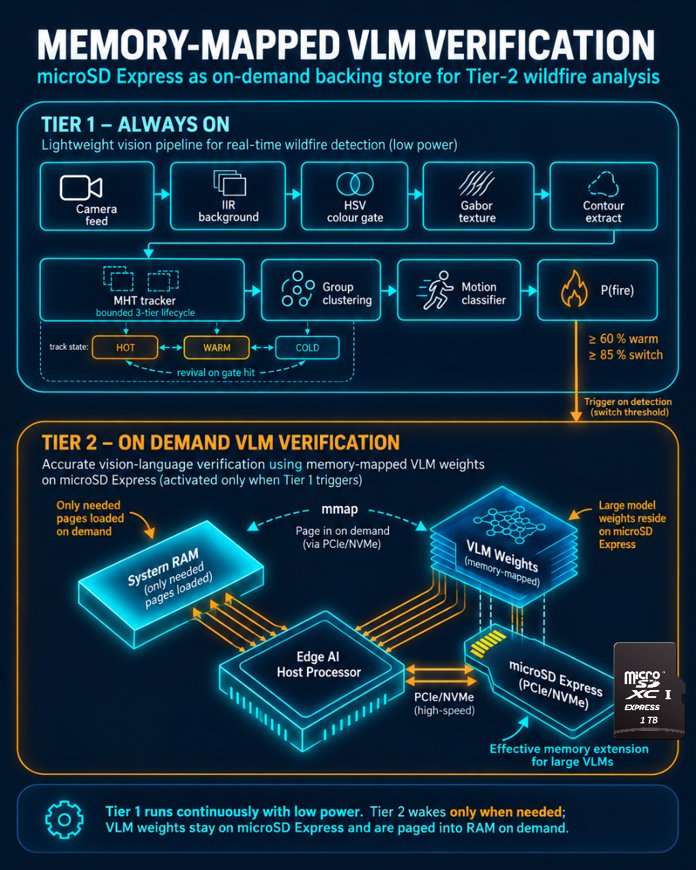
The first-place team developed WildGuard, a power-efficient wildfire detection system designed to monitor remote environments. The system uses a two-stage AI architecture, combining lightweight, continuous monitoring with a more advanced vision-language model (VLM) that activates when potential wildfire activity is detected. This approach enables the system to perform more complex analysis when necessary while limiting the computing resources required for continuous operation.
microSD Express plays an important role by storing the larger VLM AI model’s weights and making them accessible through memory mapping. Allowing a limited lower cost RAM usage rather than loading the entire model into RAM, the system retrieves the necessary data on demand. Also, in comparison to standard SSD, the microSD Express with its lower idle time power consumption was found to be the preferable solution for such a remote device. This demonstrates how microSD Express may serve as a low power removable NVMe™ storage and help overcome memory limitations in compact Edge AI devices, supporting sophisticated AI applications.
Second Place: On-Device Continual Learning for Autonomous Driving Using SD Express
The Hong Kong University of Science and Technology | $10,000 Award
Students: Law Chi Chung, Li Chun Ting, and Wong Yuk To
Supervisor: Prof. Tim Woo
The second-place team developed an autonomous driving system capable of continuously collecting data and improving its AI models while maintaining real-time vehicle operation. Using microSD Express as a persistent storage layer, the system records operational data and retrieves previously captured information for background learning. This allows the vehicle to process live sensor information while simultaneously refining its AI models.
SD Express is directly in the learning loop serving as a persistent Replay Memory layer: it must sustain concurrent writes from live logging and reads from replay without disturbing steering inference.
The team demonstrated the performance advantages of this architecture by reducing the time required to retrieve 500 recorded frames from 6.12 seconds (using UHS-I card) to 0.94 seconds with microSD Express, a 6.5-fold improvement, while maintaining zero dropped video frames. The results illustrate how microSD Express can support simultaneous data recording, retrieval, and AI model adaptation without interrupting critical real-time processes. SD Express may serve as an integral part of an AI learning loop.
Third Place (Two-Way Tie): HarvestIQ Agricultural Intelligence
University of California, Davis | $5,000 Award
Student: Luis Blas
Supervisors: Prof. Weijian Yang and Prof. Zhi Ding
HarvestIQ is an offline agricultural grading system that combines real-time AI analysis with continuous data collection. The system evaluates fruit while simultaneously recording full-resolution images, sensor information, and operator corrections. Its dual-pipeline architecture enables immediate analysis while preserving detailed information that can be used for future AI model improvements.
microSD Express memory card which carries the OS and AI Models, acts as the high-rate logging layer for the second pipeline providing the high-speed storage needed to maintain both processes in parallel. During testing at 60 frames per second, the system recorded zero dropped frames using microSD Express, compared with 32.5% frame loss using legacy UHS-I storage.
HarvestIQ is a product-oriented demonstration of SD Express enabling an Edge AI system to perform its immediate task while continuously creating the dataset needed for future model improvement.
Third Place (Two-Way Tie): Helmet-Based Threat Detection System
Technion – Israel Institute of Technology | $5,000 Award
Students: Omri Smak and Noam Gati
Supervisor: Oz Shmueli
The team developed a wearable threat detection system that combines multiple cameras, AI-powered object detection, and inertial measurement unit (IMU) tracking. Designed to capture and analyze information from multiple sources simultaneously to detect and track aerial threats.
SD Express is used as the high-speed removable data layer for synchronized multi-camera event recording, detection and IMU logs, field-dataset collection, model/configuration exchange and deterministic replay.
The project’s testing demonstrated 5.3 times faster threat-event saving and 4.6 times faster offloading of 100 GB datasets compared with UHS-I memory cards.
The project illustrates an important Edge-AI role for SD Express in maintaining continuous sensing and inference while simultaneously recording and moving large amounts of data on a compact, removable medium.
Demonstrating the Potential of SD Express as a Removable NVMe Storage
Although the winning projects addressed different applications, they shared a common objective: microSD Express allowed each project to overcome limitations associated with conventional removable storage. From accessing large AI models on demand to recording multiple data streams and supporting continuous learning, the students demonstrated how PCIe and NVMe technology can extend the capabilities of compact computing systems.
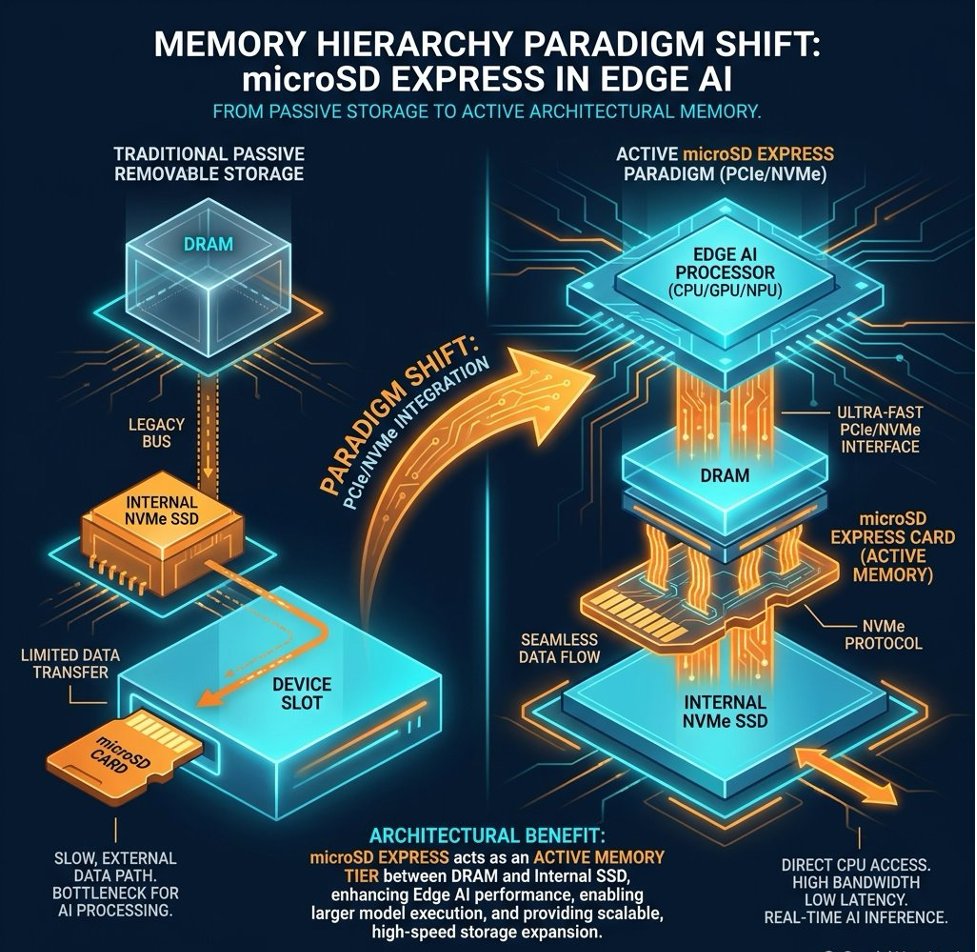
These projects reinforce an important evolution in storage architecture. SD Express is more than a faster SD memory card: It provides a standards-based, removable NVMe™ storage option that can improve system flexibility, scalability, and serviceability while supporting demanding local workloads. The winning projects offer practical examples of how developers can integrate this technology into next-generation Edge AI systems.
The SD Association congratulates all participants in the 2026 SD Express Student Competition for their technical achievements and innovative approaches to removable storage. Their work demonstrates the value of continued academic exploration and provides new perspectives on the potential applications of SD Express technology.
Looking Ahead: 2027 SD Express Student Competition
The SD Association looks forward to continuing the competition in 2027 and encouraging a new generation of engineers to explore the possibilities of SD Express technology.
Watch for additional information about participation requirements, competition guidelines, and important dates.
Learn More About the SD Express Student Competition
SD logos are trademarks licensed by SD-3C LLC.
Jetson™ is a registered trademark of NVIDIA Corporation.
PCIe® – PCI Express, is a standard developed by PCI-SIG® and PCIe® is a trademark owned by PCI-SIG.
NVMe™ – NVM Express™, is a standard developed by NVM Express Inc. and NVMe™ is a trademark owned by NVM Express Inc.